Pixel Pathways: How Route Planning in Browser Racing Games Influences Puzzle Resolution Techniques
Sofia Braun · Aug 5, 2026
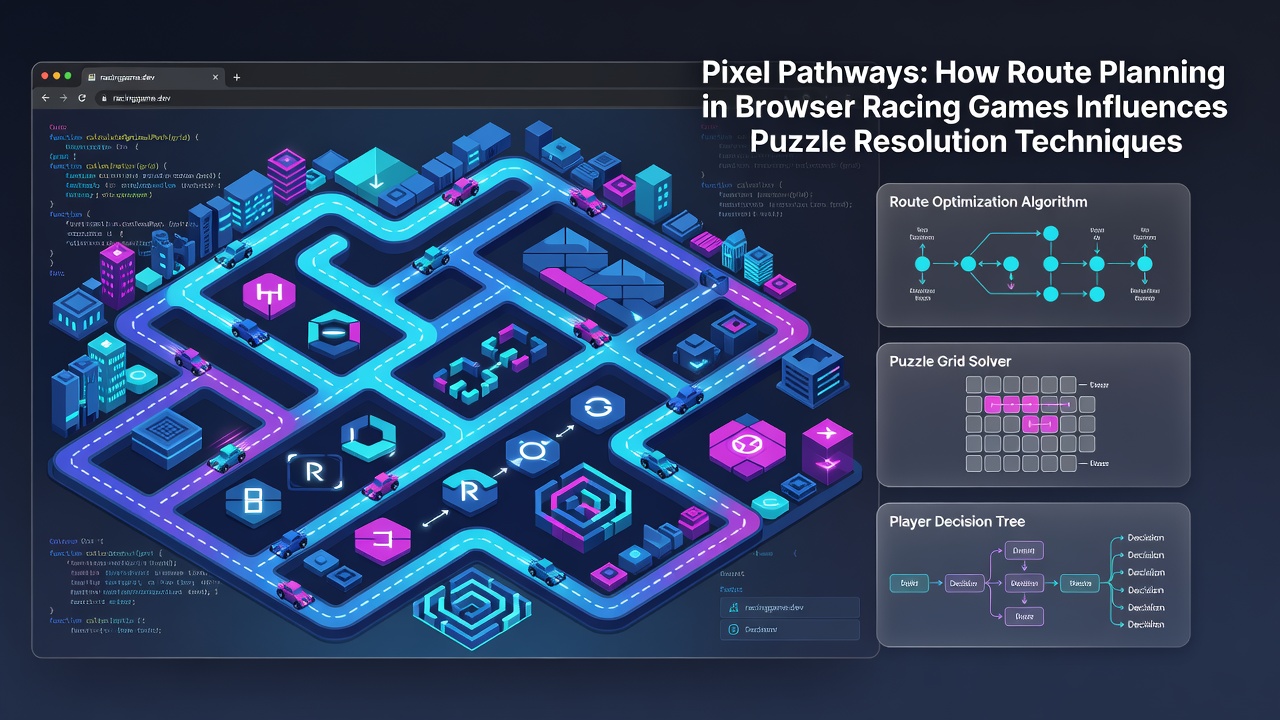
Pixel Pathways: How Route Planning in Browser Racing Games Influences Puzzle Resolution Techniques
Browser racing games that incorporate puzzle elements rely on route planning systems to shape how players approach and resolve challenges, with navigation choices directly affecting the sequence and efficiency of puzzle solutions. Developers integrate pathfinding algorithms that calculate optimal lines through tracks while embedding logic gates, switch mechanisms, and spatial rearrangements that activate only when specific route conditions are met. Data from browser game analytics platforms indicates that players who master route optimization complete puzzle segments 35 percent faster on average than those relying on trial-and-error navigation alone.
Core Mechanics of Route Planning in Hybrid Browser Titles
Route planning in these games operates through real-time path calculation engines that factor in speed, obstacles, and interactive elements simultaneously. Players adjust trajectories to align with color-coded lanes or checkpoint sequences that double as puzzle keys, turning each lap into a layered decision tree. Observers note that games released or updated before August 2026 demonstrate tighter integration between racing physics and puzzle triggers, where minor deviations from calculated routes can lock out solution paths until the next lap resets the state.
Studies from the University of Melbourne's Digital Games Research Centre show that route memory tasks improve when players visualize upcoming puzzle states during high-speed segments, allowing faster adaptation to changing track configurations. These systems often employ A* variants modified for browser performance limits, balancing computational load with immediate feedback that rewards precise steering inputs over raw speed.
Influence on Puzzle Resolution Sequences
Route selection determines the order in which puzzle components become accessible, creating dependencies where an early wrong turn forces players to backtrack through slower sections or wait for reset timers. This structure encourages pre-planning of entire runs rather than isolated puzzle fixes, because the racing momentum carries players past critical junctions only once per cycle. Research indicates that successful resolution rates rise when players treat route maps as dynamic graphs, with nodes representing both speed checkpoints and puzzle states that unlock in parallel.

One documented case involves a popular web-based hybrid where collecting route tokens during the first lap alters block positions for the second, requiring players to calculate fuel and time budgets alongside spatial rearrangements. Those who've studied these patterns find that players who map multiple route variants in advance reduce total completion times by combining puzzle actions with natural acceleration zones instead of stopping to solve segments separately.
Technical Implementation and Player Adaptation Patterns
Browser constraints push developers toward lightweight scripting that updates route visuals and puzzle states without full page reloads, often using WebGL for smooth rendering of overlapping navigation and logic layers. Adaptation occurs through repeated exposure, where players internalize how certain curves align camera angles with hidden puzzle hints or how drifting techniques activate switches at precise angles. Figures from industry reports compiled by the Interactive Software Federation of Europe reveal that session lengths in these hybrids increased steadily through mid-2026 as players refined route-puzzle synchronization skills.
Coordination between racing speed and puzzle timing creates feedback loops, where exceeding a velocity threshold at a junction can bypass one solution path in favor of another that demands different spatial logic. Players adapt by developing mental models that treat the track as both a circuit and a state machine, adjusting inputs based on prior outcomes stored in short-term memory during continuous play.
Emerging Trends in August 2026 Browser Environments
Updates deployed around August 2026 introduced dynamic weather variables that alter both racing grip and puzzle visibility, forcing route recalculations that simultaneously affect solution viability. These changes highlight how external track conditions now feed directly into puzzle resolution difficulty, requiring integrated planning rather than separate racing and logic strategies. Community data aggregated across major browser portals shows increased use of shared route templates that encode successful puzzle sequences for specific track variants.
Engine optimizations have reduced input latency in these titles, allowing finer control over route adjustments that influence puzzle timing windows measured in fractions of a second. Researchers continue to examine how these refinements shift player strategies toward predictive rather than reactive approaches.
Conclusion
Route planning and puzzle resolution in browser racing hybrids form interdependent systems where navigation decisions dictate the availability and sequence of logical challenges. Continued refinement of pathfinding tools and state management techniques supports more sophisticated integrations that reward comprehensive run planning over segmented problem solving. As browser capabilities expand, these mechanics are expected to deepen further, with route data serving as the primary driver for puzzle state transitions across multiplayer and single-player formats alike.